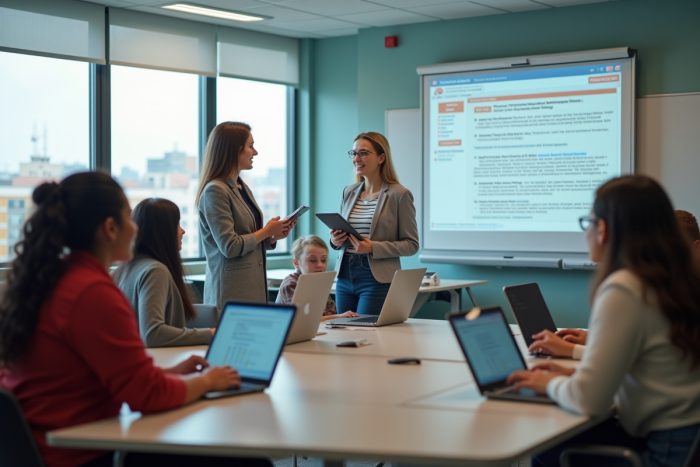
A bottomless backpack, but connected at your fingertips. This is the new daily life of students: homework no longer lingers on the living room table, it appears on the screen, always available, never lost. Léa, eight years old, no longer asks her mother for anything: her school portal delivers everything, from grades to messages from her teachers, in the cold light of her room. A school world that fits in one hand, accessible in three gestures, almost unreal.
Behind this digital ease lies another reality, less shiny. The promise of expanded access is coupled with the fear of a silent divide: every alert, every instant message, traces an invisible line. Do school portals create a bridge to autonomy, or do they dig a discreet chasm between the student and the school?
School and Digital: How School Portals Transform the Daily Lives of Students and Teachers
The generalization of digital portals disrupts the daily balances of school. The homework notebook becomes virtual, exchanges between education stakeholders happen in real-time, and educational resources are gathered in just a few clicks. Everything converges towards a logic of tracking, tracing, and centralization. In Paris, Versailles, or elsewhere, the platform MonCollège in Val-d’Oise symbolizes this transformation: homework, schedules, report cards, messages, everything is intertwined. It is no longer just a support; it has become the backbone of the new generation school organization.
- For teachers, these digital portals lighten administrative management and allow for individualized tracking. Uploading documents, correcting online, reporting an absence: everything is handled via the platform.
- For students, autonomy takes on a new dimension: homework, classes, results, everything is accessible at any time. No need to wait until the end of class or ask a classmate: the boundary between school and home blurs, almost to the point of disappearing.
The Ministry of National Education plays the conductor of this transformation, betting on learning digital skills from a young age. Simplified access to information, online educational resources, remote exchanges: the very contours of teaching are being redrawn. The platform MonCollège in Val-d’Oise is gradually establishing itself as a reference in schools, articulating the links between students, parents, and teachers, and redefining the educational community.

What Challenges and Opportunities Arise from the Generalization of Connected Tools in Education?
As the fully connected world takes hold, the boundary between school life and private life becomes blurred. Digital tools open up unprecedented perspectives, but each innovation raises new challenges: how to ensure the confidentiality of personal data? How to adapt teaching methods? How to maintain ongoing training for teachers, essential to keep pace with technological advancements? And what to think about the growing role of artificial intelligence in education, between promises of efficiency and ethical concerns?
The state, through the Ministry of National Education, is investing heavily to develop digital skills and educate on digital citizenship. In schools in Paris or Versailles, teaching teams are evolving their practices, reinventing access to knowledge and managing schoolwork. But the ground reveals disparities: depending on the territory, resources and mastery of tools vary, sometimes widening the gap between institutions.
- Training national education agents remains a priority, to support the rise of educational technologies.
- Media and information education becomes a bulwark against fake news and the virality of social networks.
Integrating digital technology into learning — video conferences, cooperative projects, tracking platforms — promises a more personalized pedagogy. But equity is never guaranteed. Technological advancements open up a field of possibilities, certainly, but they require constant attention: the quality of usage and the protection of students remain in suspense. The promise of digital in schools currently hinges on a balance as precarious as a forgotten password.