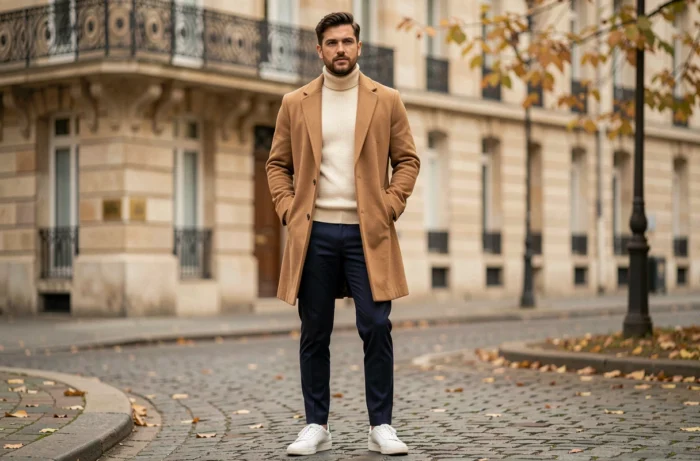
Men’s fashion is increasingly viewed through a dual prism: that of silhouettes and that of regulatory constraints that now govern textile production in France. The men’s wardrobe is evolving under the combined effect of new laws, an environmental display currently being rolled out, and stylistic trends that redefine the balance between elegance and sustainability.
Environmental display and anti-fast fashion law: what changes for the men’s wardrobe
Since autumn 2026, the Ecobalyse score allows for the calculation of a garment’s footprint by integrating climate, water consumption, biodiversity, reparability, microfibers, and a coefficient related to fast fashion. This tool concretely alters the way two seemingly similar men’s pieces are compared.
The anti-fast fashion law, for its part, requires ultra-express fashion platforms to convey messages regarding sobriety, reuse, repair, and the impact of deliveries. It also provides for a modulation of contributions from the textile sector based on the sustainability of products.
For a buyer consulting the fashion section of Soyons Sérieux or any other specialized media, these two measures transform the usual framework of understanding. Price and cut are no longer sufficient: traceability, composition, and durability become measurable selection criteria.
| Criterion | Before environmental display | With the Ecobalyse score |
|---|---|---|
| Comparison between two shirts | Price, material, cut | Price, material, cut + climate impact, water, biodiversity, reparability |
| Technical pieces (waterproofs) | Performance, aesthetics | Performance, aesthetics + PFAS restriction in France |
| Purchase on ultra-express platform | No mandatory information | Mandatory messages on sobriety, reuse, delivery impact |
| Second hand | Perceived as automatically virtuous | Variable environmental impact depending on transport, condition of the garment |
One point deserves attention: garments containing PFAS are subject to a new restriction in France. Technical waterproof pieces, which are very present in current trends (parkas, outdoor jackets), are directly affected. Checking the composition of a water-repellent garment is no longer a niche reflex.

Sustainable pieces versus trendy pieces: where to invest in your men’s wardrobe
The spring-summer and autumn-winter 2026 trends highlight leather, overshirts, natural neutral tones, burgundy, and jacquard patterns. The question arises: which of these pieces justify a sustainable investment, and which are merely seasonal effects?
Leather exemplifies this arbitration well. A well-cut leather jacket can last through several seasons without losing its stylistic relevance. The dark tones (black, green, burgundy) that dominate the season give it a visual longevity that a strongly patterned jacquard does not offer.
In contrast, certain trendy pieces like transparencies or slides remain ephemeral propositions. Their environmental cost relative to the number of actual wears is harder to justify, especially in light of the Ecobalyse score.
- High stylistic yield pieces over time: leather jacket, classic cut suit, quality fabric shirt, well-cut raw denim
- Seasonal pieces to target second hand or entry-level: highly identifiable jacquard patterns, accessories with strong trendy connotations (very noticeable checkered scarves)
- Technical pieces to check in composition: waterproof parkas, water-repellent garments, technical shoes (PFAS restriction)
Weaving quality and traceability: concrete criteria for choosing a men’s shirt or polo
Beyond cut and style, weaving quality becomes a measurable marker. Several brands are now compared based on the density of their fabric, the origin of the fibers, and the finishes. This level of detail, still marginal a few years ago, corresponds to a growing expectation in the men’s wardrobe.
A sufficiently dense weight ensures better durability in washing and a longer lifespan. For a shirt worn daily, the difference becomes evident within the first few months: a lightweight and poorly finished fabric distorts, wrinkles at the collar, and loses its shape after a few washes.
Traceability complements the approach. Knowing where the cotton was grown, where the fabric was dyed and assembled allows for cross-referencing information with the environmental score. This is not a theoretical exercise: the Ecobalyse display makes this data actionable for consumers.
Leather, vintage, and second hand: false automatism
Second hand does not automatically constitute an equivalent circuit in environmental terms. Transport, the condition of the garment, and resale conditions influence the actual balance. A locally purchased vintage jean does not have the same impact as a piece shipped from another continent.
Buying vintage remains relevant when it replaces a new purchase with low durability. Buying a well-preserved leather jacket from the 1990s avoids the production of a new piece while obtaining a garment whose style has proven itself over several decades.
Men’s fashion and foreign brands in the French market: a more regulated access
Foreign brands targeting the French market must now navigate a strengthened legal framework. The anti-fast fashion law does not only target Asian giants: any platform whose model relies on high volumes and very low prices is affected.
This framework alters the accessible offer. Brands that invest in traceability and sustainability gain visibility, while those that do not comply with display obligations lose a competitive advantage based solely on price.
The current masculine style is built as much on the choice of pieces as on the reading of their label. Environmental data, composition, origin: these elements now contribute to the purchasing decision just as much as cut or color. The men’s wardrobe of 2026 is no longer just a list of seasonal trends.