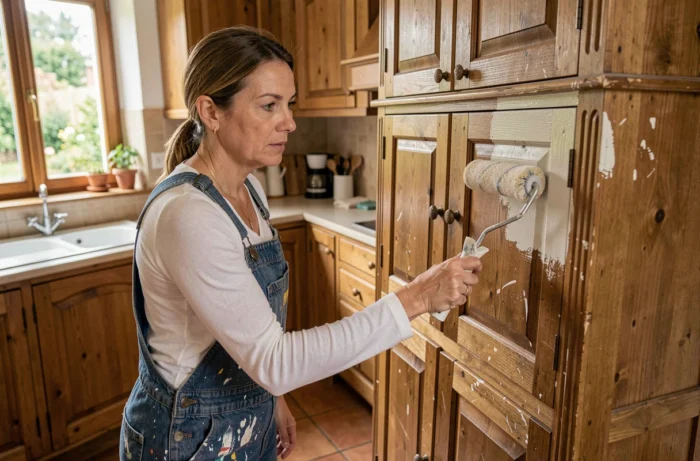
V33 renovation paints now cover around ten product ranges designed for challenging surfaces: wall tiles, kitchen cabinets, floors, woodwork and bathroom tiles. Their appeal lies in their direct adhesion, often without prior sanding or a primer.
This simpler approach appeals to homeowners who want to refresh an interior without removing existing finishes. However, each range has specific technical limitations, and misreading the product information can turn a time-saving shortcut into a costly redo.
Renovation paint or waterproofing: where to draw the line
A tiled kitchen backsplash, a laminate countertop, a tiled shower wall: all three surfaces are regularly exposed to water, steam or greasy splashes. Before opening a tin, the first question to settle is what you need the product to do.
V33 clearly states that its Bathroom paint is not a waterproofing product. It is not suitable for bathtubs, sinks or floors. On a shower wall, you must wait 48 hours before using the shower for the first time, and the paint does not reach its full resistance until after 20 days. During this period, avoid impacts, stains and cleaning.
For horizontal kitchen surfaces, the Kitchen range requires a dedicated protective varnish on countertops. The Bathroom range recommends the same precaution for vanity tops. In other words, paint alone is not enough on a horizontal surface exposed to standing water.
If the surface is subject to repeated water runoff or constant contact with water (the base of a shower tray, a sink or a bathroom floor), a waterproofing system beneath the tiles or a technical coating is still the right solution. Choosing V33 paint for renovation makes sense on a wall, cabinet or vertical tiled surface, where water does not collect.
Surface preparation: what “no sanding” means in practice
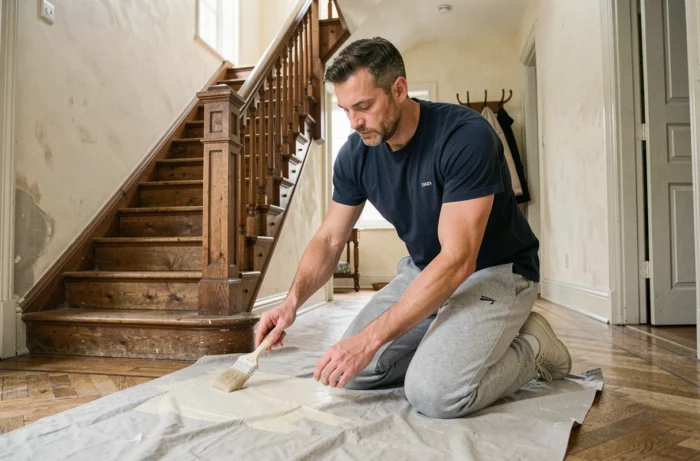
The “no sanding” claim does not mean no preparation. For the Kitchen range, V33 requires unpainted surfaces (glass, tiles, laminate) to be cleaned, rinsed and left to dry before application. On tiles coated with years of greasy splashes, this step can take a significant amount of time.
Common pitfalls with walls and cabinets
- Tiles with cracked or recessed grout must be regrouted before painting; otherwise, the paint film will crack in the same places within a few months.
- A glossy melamine cabinet coated with silicone or wax will not provide a suitable surface for adhesion, even with a high-adhesion formula. Degreasing with household alcohol or acetone is essential.
- A crumbling plaster wall or one covered with peeling old paint needs to be partially stripped. Renovation paint adheres to a sound surface, not an unstable one.
V33 universal primer, rated A+ for indoor air emissions, can be used as a base coat on the most delicate surfaces. This rating, verified at Leroy Merlin, is a useful reference when renovating a bedroom or a poorly ventilated room.
Long-term durability: the curing times labels don’t highlight
Dry to the touch and fully cured are two different things. V33’s Kitchen product information states that the paint reaches its full resistance after 20 days. For those three weeks, the surface must not be cleaned or exposed to impacts or prolonged staining.
This affects how you plan a project. Repainting a kitchen backsplash on a Saturday means protecting the area for almost a month of everyday use. For a bathroom cabinet, it means avoiding placing damp bottles on it until the paint film has hardened.
Interior wall paint versus multi-surface renovation paint
Conventional wall paint, whether acrylic or alkyd, reaches its final hardness within a few days on a plaster wall. Renovation paint is formulated to adhere to smooth surfaces (tiles, laminate, PVC) and contains resins that cure more slowly. The smoother the surface, the longer it takes to cure fully.
On a standard plaster or drywall wall, the “Renovation” range offers no advantage over an interior wall paint of comparable quality. Using specialist formulas only on surfaces that need them helps avoid unnecessary extra costs and longer drying times.
Indoor air quality and choosing V33 paint
Since regulations on labeling volatile organic compound emissions came into force, every paint tin sold in France has displayed a rating from A+ (very low emissions) to C. This criterion often takes a back seat to color or finish.
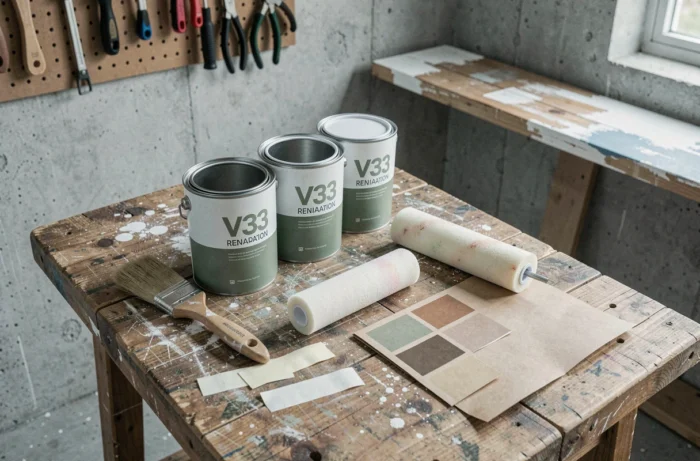
V33 universal primer is rated A+, the highest rating. Emissions ratings for renovation topcoats vary by range and product. Checking the label on the tin or the online product information is the only reliable way to compare two paints on this basis.
In an enclosed room, such as a windowless bathroom or a kitchen open to the living room, indoor air emissions matter just as much as water resistance when choosing a product. Ventilating during and after application does not make up for a poor rating if the room is inadequately ventilated day to day.
V33 renovation paint can transform interiors when used on vertical surfaces, cabinets and woodwork, provided you allow for the actual curing times and do not confuse a cosmetic refresh with technical protection. A dedicated varnish is still required on countertops. Paint is no substitute for a waterproofing system on surfaces in constant contact with water. Reading the product information all the way through, including the restrictions on use, helps avoid most problems.