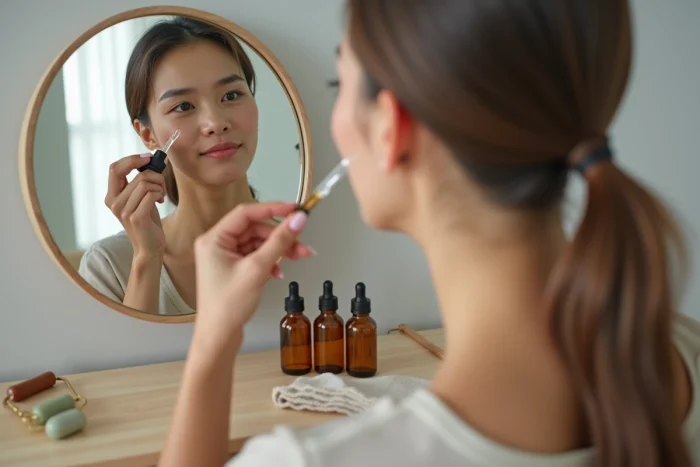
The European cosmetics market is undergoing a rapid restructuring phase. Formulations are evolving under the combined pressure of new regulations and a demand for shorter routines. Enhancing one’s beauty daily with innovative products no longer means accumulating steps, but rather choosing treatments whose composition and function meet specific criteria.
European Cosmetic Regulation and Its Impact on Innovative Beauty Products
Competitors on this topic often mention “active” or “revolutionary” ingredients without ever addressing the framework that conditions their market entry. Regulation (EU) 2024/1328, published in the Official Journal of the EU on May 8, 2024, has amended Annex II of the Cosmetics Regulation (EC) No. 1223/2009. The list of prohibited or strictly limited substances has further expanded, particularly targeting certain UV filters and preservatives suspected of endocrine effects.
For anyone looking to enhance their skin with recent treatments, this evolution has a direct consequence: an “innovative” product must first comply with a stricter regulatory framework. Brands that reformulate ahead of these restrictions gain an advantage, while others discreetly remove references from their catalog.
The SCCS (Scientific Committee on Consumer Safety) is concurrently evaluating new actives. This process creates a gap between the appearance of an ingredient in scientific research and its actual availability in a face or body care product sold in Europe.
A product presented as “cutting-edge” in an Asian or American market may simply not be authorized here. Several specialized platforms allow tracking these developments and identifying compliant formulations, such as https://www.popyourbeauty.fr/, which lists recent beauty products.
Skinimalism and Multi-Use Products: The Shortened Beauty Routine
Ten-step skincare routines are losing ground. Recent market reports confirm a marked increase in “multi-benefit” ranges, particularly among 18-35 year olds. McKinsey, in its analysis “The beauty market in 2023,” identifies “hybrid beauty” products (makeup-care, SPF-care) as a growth driver above the industry average.
This movement has a name: skinimalism, which is the voluntary reduction of the number of steps in the daily routine. A tinted serum replaces foundation and hydrating serum. A multi-purpose balm serves lips, cheeks, and the eye contour. The logic is not to do less out of laziness, but to limit interactions between actives on the skin.
Hybrid Care and Makeup Products: What Works
Not all all-in-one textures are created equal. Three criteria help sort them:
- The presence of a properly dosed SPF filter (and not just mentioned in marketing), verifiable via the INCI list and compliance with European cosmetic regulation.
- Compatibility with skin type: a rich balm is suitable for dry skin but may overwhelm combination skin. Field feedback varies on this point depending on formulations.
- The stability of the formula over time: a multi-use product containing pigments and moisturizing actives must maintain its properties after opening, which the PAO (period after opening) indicated on the packaging allows you to verify.
Fewer products in the routine does not mean less demand for each chosen product. Skinimalism works provided that cosmetics are formulated for this versatility, not simply repackaged with an expanded marketing discourse.
Natural Face Care and Organic Cosmetics: Reading Beyond Labels
The term “natural” on a beauty product does not have a unique regulatory definition in Europe. Labels (Cosmos Organic, Ecocert, Natrue) each impose different specifications regarding the percentage of natural origin ingredients, permitted processing methods, and required testing.
A face care product labeled “natural” without third-party certification may contain a majority of synthetic ingredients. In contrast, a certified organic product adheres to a specification controlled by an independent body. The difference between the two is not trivial for the skin: some synthetic preservatives permitted in “natural” non-certified formulas are precisely those that European regulation tends to restrict.
Decoding the INCI List on a Cosmetic
The INCI (International Nomenclature of Cosmetic Ingredients) list, mandatory on all products sold in Europe, classifies ingredients in descending order of concentration. The first five components represent the bulk of the formula. If “aqua” is listed first and the active touted by marketing appears at the end of the list, its actual concentration is marginal.
Two useful daily reflexes:
- Check the position of the main active: hyaluronic acid or a botanical extract listed after fragrance is present at less than 1% of the formula.
- Spot declared allergens at the end of the list: limonene, linalool, citronellol are common fragrance components. Their presence is not problematic for all skin types, but it deserves attention on a sensitive or redness-prone skin.
- Compare two similar products: a hydrating serum whose first five ingredients are almost identical to a competitor that is half the price raises questions about the real quality-price ratio.
Daily Beauty Routine: Adapting Care to the Skin’s Rhythm
The skin does not react the same way in the morning and evening. In the morning, sebum production resumes after the night, and exposure to UV and pollution begins. In the evening, the skin enters a phase of cellular repair. Applying the same products at both times ignores this cycle.
A gentle morning cleanse (without aggressive surfactants) followed by a hydrating treatment with SPF constitutes a minimal foundation. In the evening, effective makeup removal followed by targeted care (retinol, niacinamide, or simple vegetable oil depending on tolerance) takes advantage of the nighttime regeneration window. Adapting products to the skin’s circadian rhythm amplifies their effectiveness without multiplying layers.
The available data do not allow for a universal optimal duration between each step. The recommendations to “let sit for two minutes” between serum and cream are based more on formulators’ observations than on published clinical studies. The most reliable approach remains to observe the reaction of one’s own skin over several weeks before modifying a routine.
The cosmetics market is evolving rapidly, and yesterday’s benchmarks (number of steps, star ingredients, promises on packaging) are no longer sufficient. The actual composition, regulatory compliance, and adaptation to skin type remain the three most reliable filters for choosing beauty treatments that deliver on their promises.