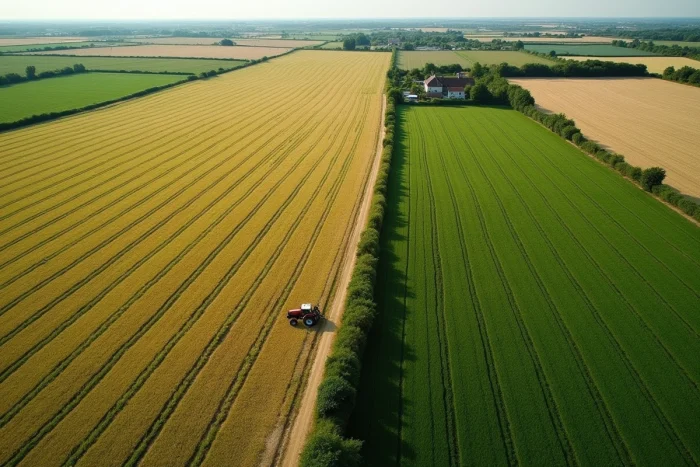
Fifty hectares is 500,000 square meters. The figure seems abstract, and converting it into square meters doesn’t really help to visualize the area. To anchor this measurement in reality, it needs to be compared to visual landmarks that everyone knows, and then examine what this area really implies in terms of land use, land constraints, and agricultural yield.
Measuring 50 hectares by walking time and physical fatigue
The usual comparisons with football fields or urban parks have their limits. They provide a visual order of magnitude but not a physical sensation. To grasp what 50 hectares represent, the body is a better measuring instrument than the imagination.
A square of 50 hectares has sides of about 707 meters. Walking along its four edges takes about forty minutes at a normal pace. Crossing the plot diagonally, which is one kilometer in a straight line, takes about twelve minutes on flat and clear ground. On plowed agricultural land, the time can double.
To understand 50 hectares with Immobilier du Net, one can also reason in terms of visibility: a person standing at the center of a square of this size cannot clearly distinguish the fences or hedges at the edges. The plot exceeds the field of immediate perception, which radically differentiates it from a large garden or a sports field.

50 hectares in agriculture: sufficient area or fragile operation
In France, the average agricultural area per farm varies greatly depending on the regions and types of production. Fifty hectares is a size that places a farm in an intermediate zone, neither a micro-farm nor a large cereal structure.
What 50 hectares can produce
The economic viability of a farm of this size depends on the type of crop or livestock practiced. In large-scale crops (wheat, rapeseed, barley), 50 hectares remain below the profitability threshold in most cereal basins in northern France, where farms often exceed double this area.
On the other hand, for higher value-added productions (diversified market gardening, viticulture, fruit growing), 50 hectares represent a considerable area, sometimes difficult to exploit without a significant workforce.
- In viticulture, estates of 50 hectares are among the largest in certain appellations, particularly in Burgundy or the Rhône Valley
- In extensive cattle farming, this area supports a modest-sized herd, insufficient to generate a full income without diversification
- In organic market gardening, managing 50 hectares requires advanced mechanization or a team of several permanent employees
Land pressure and Zero Net Artificialization goal
The ZAN regulation, strengthened in recent years, changes the game for plots of this size. Communities must halve the rate of land artificialization by the next decade, making large agricultural lands both more difficult to convert into buildable zones and potentially more valued on the land market.
Fifty hectares in peri-urban areas do not have the same value as in deep rural areas. Near urban centers, the pressure to convert remains strong despite the ZAN. In rural areas, these plots can remain accessible at moderate prices, but their agricultural profitability depends on climatic and logistical factors that available data do not always allow to anticipate.
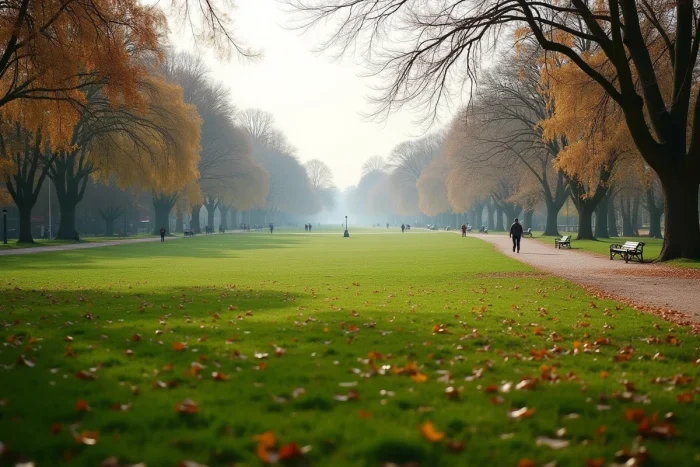
Visual comparisons with known sites to visualize 50 hectares
The Tuileries Garden in Paris covers about thirty hectares. Fifty hectares is therefore this garden plus a good third. The Parc de la Tête d’Or in Lyon, often cited as the largest urban park in France, spans about 105 hectares: 50 hectares represent roughly half of that.
A medium-sized airfield occupies an area comparable to 50 hectares. The runway, taxiways, and clearance areas of a small regional airport give a fairly accurate idea of the ground footprint.
For sports enthusiasts, 50 hectares correspond to about 70 standard football fields lined up side by side. The image is striking, but it remains theoretical: no one has ever seen 70 football fields lined up.
Climate change and the future of 50-hectare plots
Research findings available on 50-hectare areas rarely address the climate impact on plots of this size. The risks are, however, documented: repeated droughts, late frost episodes, and changes in crop cycles directly affect the profitability of farms.
On 50 hectares, crop diversification is a lever for adaptation. A farm of this size can theoretically spread risks across several productions, provided it has sufficiently varied soils and access to water. Field feedback varies on this point: some 50-hectare plots exhibit soil homogeneity that limits diversification possibilities.
- Plots in the Mediterranean zone face increasing water stress, reducing yields of non-irrigated crops
- In the continental zone, late spring frost episodes threaten fruit and wine productions
- Adaptation often involves investments (irrigation, windbreak hedges, drainage) whose cost weighs more heavily on medium-sized farms
The question of the long-term viability of a 50-hectare farm is therefore not just a matter of surface calculation. It depends on the soil, local climate, access to water, the type of production chosen, and the current regulatory framework. The area alone says almost nothing about the real value of land.