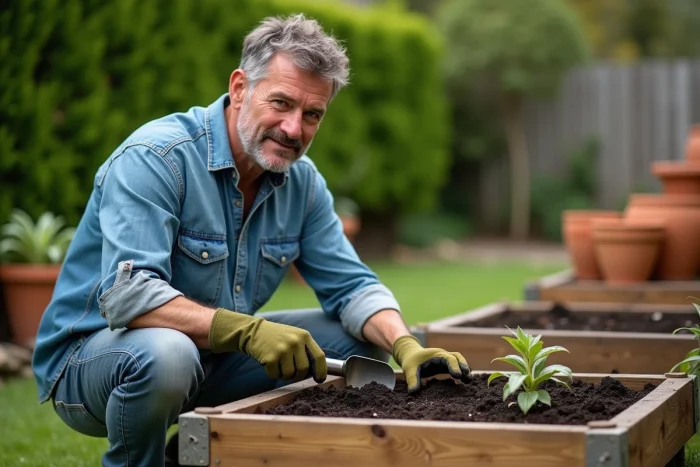
Clay soil that sticks to boots after every rain, a hedge of privet overflowing onto the sidewalk, sparse grass around the vegetable garden: every garden presents its own problems even before discussing equipment. Choosing the right tools to design and maintain a garden starts with what you see outside, not from a generic list.
Interchangeable battery platform: the choice that determines everything else
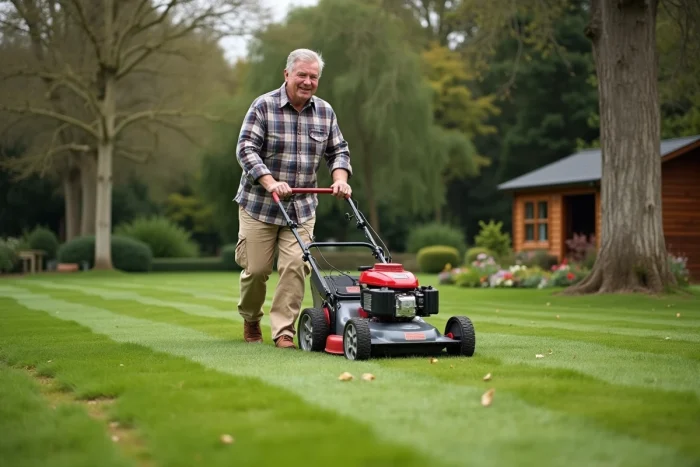
When purchasing your first powered tool, you’re not just choosing a lawn mower or hedge trimmer. You’re committing to an ecosystem. Since 2024, manufacturers like Stihl, Husqvarna, Gardena, and Ryobi offer complete ranges of interchangeable battery tools: a single battery powers the lawn mower, blower, chainsaw, and hedge trimmer.
The practical advantage on the ground is that you avoid accumulating incompatible chargers at the back of the garage. You buy a first tool with its battery, then complete the range with devices sold “bare” (without battery), often at much lower prices.
If your garden is less than a few hundred square meters, a medium-capacity battery is sufficient for a complete mowing. Beyond that, you need either a more powerful battery or two batteries in rotation. Browsing the equipment on Clic Garden allows you to compare the available platforms and their compatibilities before committing to a brand.
The reduction of noise is a frequently cited argument by manufacturers, and feedback confirms it: a dense neighborhood tolerates a battery-powered lawn mower on a Sunday morning better than a two-stroke gas engine.
Moisture sensors and Wi-Fi timers to adapt watering to water restrictions
Since the repeated drought episodes in France starting in 2022, prefectural orders limiting watering have become common. Watering “by feel” leads to waste or, worse, fines during restrictions.
Soil moisture probes change the game. Planted about ten centimeters deep, they transmit real-time moisture levels to a connected timer. Watering only occurs when the soil actually needs it.
Since 2023, Gardena and Netatmo have been promoting the adaptation of these systems to drought constraints. A Wi-Fi timer connected to a garden weather station can automatically suspend watering if rain is forecasted or if a drought order is active in the area.
What we install concretely
- One moisture probe per planting area (vegetable garden, flower bed, lawn), as water needs differ depending on the plants and exposure
- A Wi-Fi timer connected to the outdoor faucet, controllable from a smartphone to adjust the time slots
- A rainwater collector, even compact, to have a reserve off-grid during the most severe restrictions
Feedback varies on the reliability of entry-level probes, which may lose connection in very wet soil. It’s better to invest in a model from a recognized brand than to multiply low-end sensors.
Portable equipment for small gardens and rental spaces
Not everyone has a homeowner’s lot in suburban neighborhoods. The development of urban micro-gardens and rental gardens has given rise to a category of equipment designed to be disassembled and moved without leaving a trace.
We’re talking about wheeled planter boxes, folding garden tables, and compact rainwater collectors that fit on a balcony. For a tenant, the challenge is reversibility: not sealing anything, not drilling, being able to take everything back when moving out.
Multi-purpose hand tools rather than a complete range
In a small space, a quality trowel, a pruner, and a hand rake cover most tasks. Three well-chosen tools replace a dozen unnecessary purchases. We favor handles made of wood or lightweight aluminum, with heads made of stainless steel that resist the humidity of a balcony.
Condominium regulations sometimes impose limits on the weight of planters or on water drainage. Check these constraints before investing in a planter that is too heavy once filled with moist potting soil.
Soil maintenance and pruning: adapting the tool to the type of terrain
Clay soil is not worked like sandy soil. A classic spade sinks and sticks in clay, whereas a grelinette aerates without turning the layers, preserving the microbial life of the soil.
For pruning, the choice between anvil pruner and bypass pruner depends on the wood. The bypass pruner cleanly cuts green stems and living branches. The anvil model is better suited for dead and dry wood, where the crushing pressure is unlikely to harm the plant.
- Grelinette or fork spade for heavy soils (clay, compacted earth), to be used after light rain when the soil is soft
- Garden fork or hoe to break the surface crust on calcareous or loamy soil
- Ratchet pruner for branches over a few centimeters in diameter, in addition to the pruner
- Battery hedge trimmer for long hedges, checking compatibility with your existing battery platform
A common mistake is to buy a powered tool for a task that a manual tool can do just as well in five minutes. A sharp pruner remains faster than a hedge trimmer for three rose bushes.
Storage and maintenance of gardening equipment
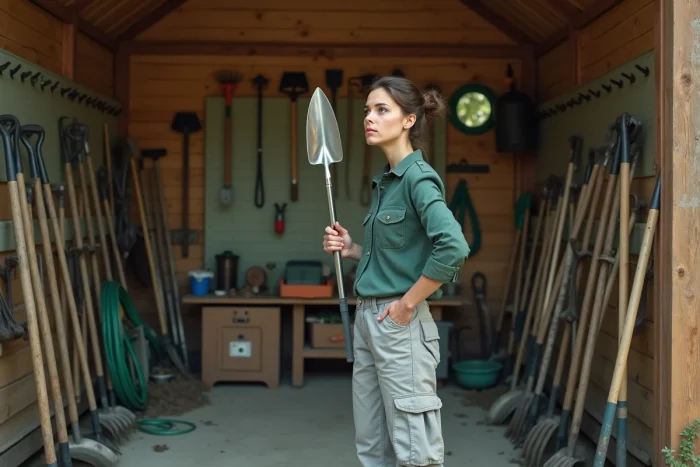
Poorly stored tools rust, dull, and end up costing more in replacements than a proper shed. A simple perforated wall panel in a garden shed, with suitable hooks, keeps each tool visible and accessible.
After each use, brush the soil off the blades, and wipe a oiled cloth on the metal parts. Batteries should be stored at room temperature, never in an uninsulated garage in winter, or you risk losing capacity.
The good reflex at the end of the season: sharpen pruners and mower blades, drain the watering circuits before frost, and check the condition of the seals on the connected timer. An annual maintenance of two hours extends the lifespan of the equipment by several seasons.