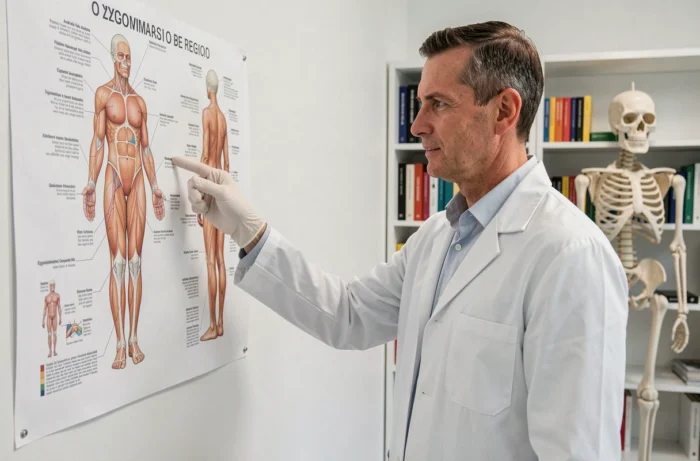
The letter Z closes the alphabet, and anatomical terms beginning with this letter can be counted on one hand. The challenge isn’t the number of words available, but their nature: several entries refer to the same bone or muscle, while others are slang rather than medical terminology.
This article sorts anatomical terms beginning with Z by their actual category and reliability.
Anatomical terms beginning with Z: table by category and register
Lists for word games often mix bone names, adjectives used as nouns, and slang words. The table below classifies the main terms you’re likely to encounter to clarify their status.
| Term | Anatomical category | Register | Brief definition |
|---|---|---|---|
| Zygoma | Bone (skull) | Medical | Cheekbone; forms the lateral wall of the orbit |
| Zygomatic bone | Bone (skull) | Medical | Synonym for zygoma |
| Zygomatic (muscle) | Muscle (face) | Medical | Smile muscle (zygomaticus major and minor) |
| Zygomatic arch | Bony structure (skull) | Medical | Bony bridge between the temporal bone and the zygomatic bone |
| Zonule (of Zinn) | Ligament (eye) | Medical | Fibers connecting the ciliary body to the lens |
| Zeugopod | Limb segment | Comparative anatomy | Intermediate part of a limb (forearm or lower leg) |
| Zakar / Zébi / Zob | Genital organ | Slang / informal | Terms not recognized by official anatomical nomenclature |
The conclusion is clear: most entries beginning with Z revolve around the zygoma. The zygomatic bone, zygomatic muscle, and zygomatic arch share the same Greek root (zygon, meaning yoke) and refer to related but distinct structures.
Each body part beginning with Z should therefore be considered individually to determine whether it’s an acceptable answer in a word game or anatomy exercise.

Zygoma, zygomatic bone, zygomatic arch: three answers or just one?
This is the question that trips up the most word-game players. Zygoma and zygomatic bone refer to exactly the same bone. The cheekbone contributes to the structure of the orbit and provides attachment points for the muscles used in chewing and smiling.
The zygomatic arch, by contrast, is a distinct structure. It forms a bridge between the zygomatic bone (at the front) and the zygomatic process of the temporal bone (at the back). The temporalis muscle passes beneath this arch to attach to the mandible.
The zygomatic muscles
The term “zygomatic” also describes two muscles of the face. The zygomaticus major pulls the corner of the mouth upward and outward: it is the main muscle used in smiling. The less prominent zygomaticus minor contributes to expressions of sadness by pulling the upper lip upward.
In a word-game context, accepting “zygomatic” as a body part is valid, provided you specify whether you mean the bone or the muscle. Both are distinct anatomical structures.
Zonule of Zinn: the eye’s invisible ligament
The ciliary zonule, also called the zonule of Zinn, is a network of very fine fibers that suspends the lens in the eye. These fibers connect the ciliary body to the edge of the lens and enable the mechanism of visual accommodation.
When the ciliary muscle contracts, the zonular fibers relax and the lens becomes rounder for near vision. When the muscle relaxes, the fibers tighten and flatten the lens for distance vision.
This term is less familiar than “zygomatic” but is perfectly acceptable in a word game. It refers to a specific anatomical structure documented in ophthalmology textbooks.

Zeugopod: a comparative anatomy term useful for word games
The zeugopod is the intermediate segment of a limb. In humans, it corresponds to the forearm (radius and ulna) in the upper limb and the lower leg (tibia and fibula) in the lower limb.
This term belongs to the vocabulary of comparative anatomy, which is used to describe limb structure in tetrapod vertebrates. It is not part of everyday medical language, but it remains a legitimate anatomical term and is included in specialist dictionaries.
What the zeugopod reveals about limb organization
The limb is divided into three segments: stylopod (arm or thigh), zeugopod (forearm or lower leg), and autopod (hand or foot). This classification makes it possible to compare limb anatomy across very different species, from lizards to humans.
Slang terms beginning with Z: why they don’t belong in an anatomical list
Several online lists include words such as zakar, zébi, or zob. All of these terms refer to the penis, but none appears in international anatomical nomenclature.
- Zakar is a word of Hebrew origin sometimes cited in religious contexts; no specialist terminology source recognizes it as an anatomical term
- Zébi and zob are French-language slang and do not appear in medical dictionaries
- Zigomar, sometimes included in lists, is a familiar nickname with no anatomical meaning
None of these words should appear in a rigorous anatomical list. In a word game with flexible rules, whether they’re accepted is up to the players. They are not acceptable in a school or university assignment.
Summary: which terms beginning with Z to use in different contexts
- For an anatomy class: zygoma (or zygomatic bone), zygomatic muscle, zygomatic arch, zonule of Zinn
- For a word game: the four terms above, plus zeugopod to expand your options
- For a casual game among friends with flexible rules: zébi or zob might be accepted, as long as everyone is comfortable with the slang
The letter Z remains the poorest letter of the alphabet when it comes to anatomical vocabulary. The reliable terms boil down to five genuinely distinct entries: zygoma, zygomatic muscle, zygomatic arch, zonule of Zinn, and zeugopod. Everything else is either a duplicate or slang.